
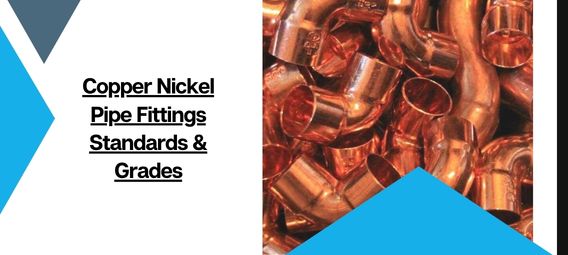
Copper nickel alloys have been the material of choice for marine and seawater piping systems for decades, and for good reason. Copper nickel pipe fittings combine corrosion resistance, anti-biofouling properties, and long service life in environments where stainless steel and carbon steel corrode rapidly. From offshore platforms to desalination plants and naval vessels, these fittings are specified because they survive where other alloys fail. This guide covers what you need to know about the types, standards, grades, and selection criteria for copper-nickel pipe fittings in industrial piping systems.
What Are Copper Nickel Pipe Fittings?
Copper nickel pipe fittings are piping components consisting of a copper-nickel alloy, often with a 90/10 or 70/30 copper to nickel ratio, used to join, reroute, or terminate piping runs. They are available in seamless and welded construction based on pressure requirements and production parameters. Industries select copper nickel alloys for their resistance to corrosion in seawater without the complicated maintenance schedules associated with stainless steel in saltwater service. The alloy’s intrinsic resistance to biofouling lowers the build-up of marine organisms on internal surfaces, which is a substantial operational benefit for constantly operating seawater systems. Read more about Copper Nickel Buttweld Fittings Applications for more details about applications.
Types of Copper Nickel Pipe Fittings
Copper Nickel Elbow
Elbows redirect flow direction; 45° and 90° are the standard configurations. In copper nickel piping systems, long-radius elbows are preferred where fluid velocity is high, reducing erosion at the change of direction.
Copper Nickel Tee
Tees split or combine flow between a main run and a branch line. Equal tees handle the same diameter throughout; reducing tees step down from the main to a smaller branch.
Copper Nickel Reducer
Reducers transition between two different pipe diameters. Concentric reducers align on the centerline; eccentric reducers offset the bottom of the pipe important in process piping where drainage and liquid accumulation must be controlled.
Copper Nickel Stub End
Stub ends are used with lap joint flanges, allowing the flange to rotate freely for alignment during assembly, a practical advantage in tight installation spaces on marine and offshore systems.
Copper Nickel Cap
Caps terminate pipe ends either as permanent closures or temporary blanks during commissioning and maintenance.
Copper Nickel Cross
Cross fittings provide four-way flow connections used in distribution networks where multiple branches originate from a single point.
Copper Nickel Buttweld Pipe Fittings
Copper nickel buttweld pipe fittings are welded directly to the end of the pipe to provide a smooth, continuous interior bore with no shoulder or restriction at the connection. Buttweld connections can withstand higher pressure and temperature and outperform threaded fittings in systems that experience vibration and thermal cycling. Manufacturing processes include hot forming and cold forming, and the ideal solution for critical pressure service is seamless fittings. Copper Nickel Buttweld Fittings are the standard specification in naval, offshore, and desalination piping where joint integrity is non-negotiable.
Copper Nickel Pipe Fittings Standards
Major standards governing copper nickel pipe fittings include the following:
- ASTM B366 standard for factory-made wrought nickel and nickel alloy fittings; governs the chemical and mechanical requirements for copper nickel fittings
- ASME B16.9 dimensional standard for factory-made buttweld fittings: defines dimensions, tolerances, and pressure-temperature ratings for standard pipe sizes
- ASME B16.28 covers short radius elbows and returns, a common configuration in space-constrained marine and offshore piping
- MSS SP-43 lightweight buttweld fittings for low-pressure service; commonly specified in HVAC and utility piping
- ANSI standards apply to end connections, facing types, and general dimensional compatibility across the system
Copper Nickel Pipe Fittings Grades
Copper Nickel 90/10 (C70600)
The 90/10 grade contains 90% copper and 10% nickel. It offers excellent seawater corrosion resistance and good anti-fouling performance, and is easier to fabricate than the 70/30 grade. It’s the most widely specified copper nickel grade in general marine and offshore piping service. Mechanical properties suit standard pressure ratings in seawater systems, and its thermal conductivity makes it effective in heat exchanger applications.
Copper Nickel 70/30 (C71500)
The 70/30 grade increases nickel content to 30%, improving corrosion resistance and strength, particularly at elevated temperatures and in high-velocity seawater environments where the 90/10 grade may experience erosion-corrosion. It handles higher-pressure service and suits applications in fast-flowing seawater systems, condensers, and offshore production equipment where the extra performance justifies the higher material cost.
Copper Nickel Reducer Specifications
Copper nickel reducers are available in both concentric and eccentric configurations. Concentric reducers suit vertical piping runs where flow symmetry is required. Eccentric reducers are specified in horizontal runs to maintain a level invert critical in liquid lines where air pockets or liquid accumulation at the reducer could cause operational problems. Copper Nickel Reducers handle full system pressure and temperature ratings, and their dimensional specifications follow ASME B16.9 for standard pipe sizes.
Advantages of Copper Nickel Pipe Fittings
- Seawater corrosion resistance: Copper nickel alloys form a protective oxide film in seawater that resists further attack, giving them a service life measured in decades, not years
- Anti-biofouling properties: The alloy’s natural toxicity to marine organisms reduces biofilm and barnacle accumulation on internal surfaces without chemical treatment
- Long service life: Systems built from copper nickel fittings routinely exceed 25-year design lives in seawater service with minimal maintenance
- High durability: The alloy withstands the erosion-corrosion that degrades less resistant materials in high-velocity seawater flow
- Low maintenance: Reduced corrosion and fouling translate directly into lower inspection frequency and intervention cost
- Strong thermal conductivity: Makes copper nickel fittings effective in heat transfer applications alongside their piping role
Industries Using Copper Nickel Buttweld Fittings
Refer to the key industries below that rely on the corrosion resistance and anti-biofouling properties of copper nickel buttweld fittings:
Marine and Shipbuilding
Copper nickel fittings are standard for vessel seawater cooling, ballast water piping, and firefighting systems due to their exceptional marine corrosion resistance and compatibility with cathodic protection systems.
Offshore Oil & Gas
Offshore platforms often use these fittings throughout topside seawater injection systems, cooling water circuits, and fire deluge networks to handle the harsh, salt-spray environments.
Desalination Plants
Both thermal and the process of reverse osmosis (SWRO) facilities require these fittings in seawater input and brine handling lines to prevent excessive chloride corrosion and biofouling.
Power Generation
Copper nickel fittings are used in seawater-cooled condensers and heat exchangers at coastal and offshore power sources because they are good at conducting heat and last a long time.
Chemical Processing
In facilities where chloride-rich process streams or aggressive cooling water contact piping networks are present, this alloy significantly outperforms standard stainless steel grades in overall service life.
How to Choose the Right Copper Nickel Pipe Fittings
Match pipe size and schedule to confirm dimensional compatibility. Not all fitting sizes are available in all schedules. Verify the pressure rating against the system design pressure and temperature range. Confirm that the operating environment suits the selected grade: 90/10 for standard marine service, 70/30 for high-velocity or elevated-temperature applications. Check standards compliance ASTM B366 for material and ASME B16.9 for dimensions are the baseline requirements.
Conclusion
Copper nickel pipe fittings offer the corrosion resistance to seawater, anti-biofouling performance, and long service life that the marine, offshore, desalination, and power generation industries need. 90/10 for normal service and 70/30 for demanding applications, the fitting will perform for the whole design life of the system if the relevant standard and the right grade are selected. Feel free to contact us immediately for high-quality Copper Nickel Pipe Fittings, Copper Nickel Reducers, and Copper Nickel Buttweld Fittings in various standards and grades with full material certification and global supply capacity.